

Kuningan has one of the highest concentrations of international families in Jakarta, and a matching concentration of schools that describe themselves as international. The word carries no fixed meaning here. Before committing, four things are worth checking yourself: the accreditation and who recognises it, who is actually in the classroom, the real commute, and the full cost rather than the headline fee.
The decision most families make too late
Families arriving in Jakarta tend to solve problems in the order they feel urgent. Housing first you need somewhere to sleep. Then a car and a driver, then a bank account, then the phone number, then the internet.
School comes somewhere after that.
By the time it surfaces, the family has usually signed a lease. And a lease sets the commute for the next two years, which quietly narrows the school shortlist to whatever sits within a tolerable drive of an address chosen before the shortlist existed.
The order that works better is the reverse: shortlist schools first, visit two or three, then choose the neighbourhood around the one you pick. In Jakarta, thirty minutes of distance on a map can be an hour of traffic twice a day, and that hour is paid by a seven-year-old.
If you have already signed the lease, this is still worth reading. It simply means the location filter in section three matters more for you than for someone still deciding.
How international schooling actually works in Jakarta

Three things surprise most arriving families.
“International” is not a protected term, but “SPK” is. Since 2014, schools in Indonesia operating in partnership with a foreign curriculum provider have had to register as a Satuan Pendidikan Kerja Sama — SPK. The framework is set by Permendikbud No. 31 Tahun 2014, and it carries real conditions:
- The foreign partner institution must be accredited or recognised in its own country so the credential behind the curriculum is checkable, not self-declared.
- At least 30% of teaching staff must be Indonesian citizens, and 80% of non-administrative education staff.
- Indonesian students must be taught Bahasa Indonesia, Pendidikan Agama and Pendidikan Pancasila dan Kewarganegaraan regardless of the international curriculum.
This is why “is your school a registered SPK?” is a better question than “is your school really international?” One has a documented answer; the other does not.
Year groups do not map cleanly onto the Indonesian system. Schools following a British structure count in Years, and Year 1 is not the equivalent of Indonesian SD kelas 1 — it sits earlier. Ask any school to place your child by age and by prior curriculum, in writing, before you assume a year group.
Bahasa Indonesia is not optional. As the SPK rules above make clear, Indonesian students take Bahasa Indonesia, religious education and Pancasila/civics whatever the international curriculum. This is a legal requirement, not a school’s own initiative treat it as a baseline every registered school meets rather than a differentiator.
Four things you can check yourself
You do not need to take a school’s word for any of these. Each one has a document, a number, or an address behind it.
| What to check | The question to ask | What a good answer looks like |
| Accreditation | Which bodies accredit you, and can I see the certificate? | Named organisations you can look up independently — not “international standards” |
| Who is in the room | How many children per class, and how many adults? | A specific number for both, with what happens when the cap is exceeded |
| The real commute | How long does the trip take at 6.45 a.m., not at noon? | An honest answer, including which residential areas are realistic |
| The full cost | What is the total first-year outlay, including one-off items? | A written schedule covering registration, development fees, uniform, books, transport, trips |
Accreditation, and who recognises it
The names that carry weight are the ones you can verify without the school’s help and all the main ones can be checked from your own laptop:
- Cambridge Assessment International Education maintains a public directory of its registered schools.
- The International Primary Curriculum and International Middle Years Curriculum are run by an identifiable organisation you can contact directly.
- SPK registration is a matter of public record with the Ministry of Education.
Ask for the certificates too. A school that holds them will send them the same day.
The reason this matters more than it might seem: accreditation is what makes a qualification portable. If your posting ends early and the family moves to Kuala Lumpur or back home, an IGCSE transfers. An unaccredited internal programme does not.
Who is actually in the classroom
Class size is the number most parents ask about and the one most brochures answer vaguely. “Low adult-student ratios” is not a number.
Ask two things instead: the maximum children per class, and the number of adults with them. A class of twenty with two teachers is a materially different room from a class of twenty with one.
The second question matters especially for a child who has just changed country, language and friendship group in the same month.
Location, and what the commute really costs
Kuningan is one of Jakarta’s more established expatriate areas a central business district with a large international community and residential towers within walking or short-driving distance of several schools.
That density is the practical argument for the area. A school inside Kuningan is reachable from Setiabudi, Rasuna Said, Casablanca and Mega Kuningan without crossing the city.
Ask the school which residential buildings its families actually live in. It is a more useful answer than a map, because it tells you where the commute has already been proven to work.
The full cost, not the headline fee
The annual tuition figure is rarely the amount you pay in year one. Registration, development or building fees, uniform, books, technology, transport and trips can add materially, and some are one-off while others recur.
Ask for the complete schedule in writing, covering the first year and the following year. A school that provides it readily is telling you something about how it will handle every other administrative question over the next decade.
Where Regality Academy fits
Regality Academy — Sekolah Royal Tunas Mulia — has operated in Kuningan since 2012, at The Kuningan Place on Jl. Kuningan Utama. It is a registered SPK school and a Cambridge International School. Against the four criteria above, here is what is on the record.
Accreditation. Cambridge Assessment International Education, the International Primary Curriculum, the International Middle Years Curriculum, membership of the Association of National Plus Schools (ANPS), and The Leader in Me, the school-wide leadership programme built on Stephen Covey’s 7 Habits. It is a registered SPK school. Every one of these is independently checkable.
The pathway. The British Early Years Foundation Stage framework in Nursery and Kindergarten. The International Primary Curriculum through Years 1 to 6, with English literacy following the National Curriculum for England and mathematics following the Singapore curriculum. Cambridge Upper Primary for English, Maths and Science in Years 7 to 9, with Social Studies through IMYC, then Cambridge IGCSEs in Years 10 and 11.
That is a single connected route from Nursery through to Year 11, ending in a qualification recognised by universities worldwide.
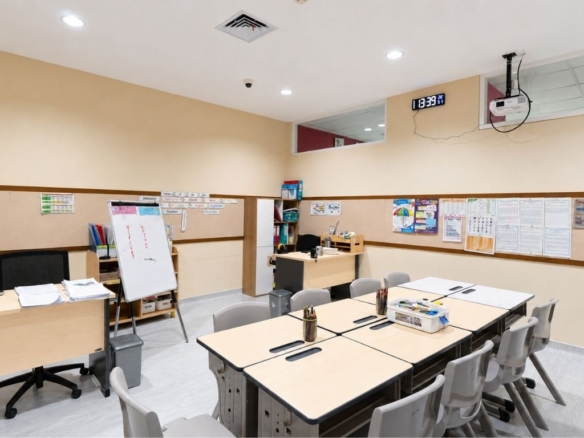
Who is in the room. Classrooms pair one expatriate teacher with one local teacher international fluency and familiar support in the same room.
The campus. Four purpose-built floors: a 30-metre swimming pool, gymnasium, science laboratory, library, ICT room, canteen, school clinic, a mini auditorium and the 1,000-seat Eagle Auditorium.
What we cannot tell you here. Fees. Like most Jakarta international schools, Regality Academy quotes on request rather than publishing online so ask for the full first-year schedule using the standard in section four above.
Your next step
If you are still shortlisting, the most useful thing you can do is visit. Brochures are written; corridors are not.
Regality Academy opens its campus for two days — 18 and 19 September, 9 a.m. to 3 p.m., at The Kuningan Place, Lumina Tower, Jl. Kuningan Utama Lot 15. You can walk the four floors, meet teachers, and ask the four questions in this guide in person.
Arrange Visit to Regality Academy
Frequently asked questions
What is an SPK school in Indonesia? SPK stands for Satuan Pendidikan Kerja Sama, the formal category for schools running an international curriculum in partnership with a foreign institution. It is governed by Permendikbud No. 31 Tahun 2014, which requires the foreign partner to be accredited in its own country, sets a minimum proportion of Indonesian teaching staff, and requires Indonesian students to study Bahasa Indonesia, religious education and Pancasila/civics.
How much does an international school in Kuningan cost? Fees vary widely and most Jakarta international schools quote on request rather than publishing online. Third-party school directories sometimes list indicative ranges, but these are not maintained by the schools and can be out of date. Ask each shortlisted school for a written first-year schedule instead — registration, development fees, uniform, books, technology, transport and trips — and compare totals rather than headline tuition.
What is the difference between IPC, IMYC and Cambridge? They serve different ages. The International Primary Curriculum is a thematic programme for roughly ages three to twelve. The International Middle Years Curriculum is designed for eleven to fourteen-year-olds around adolescent development. Cambridge provides the structured upper-secondary route ending in IGCSE qualifications. Many schools use them in sequence rather than choosing between them.
Do international schools in Jakarta still teach Bahasa Indonesia? Yes. Under Permendikbud No. 31 Tahun 2014, Indonesian students at SPK schools must study Bahasa Indonesia, religious education and Pancasila/civics alongside the international curriculum. It is a legal requirement, so treat it as a baseline every registered school meets.
Is Year 1 the same as Indonesian kelas 1 SD? No. In a British structure, Year 1 sits earlier than Indonesian kelas 1 SD. Ask the school to confirm placement in writing based on your child’s age and previous curriculum before assuming a year group.

Join The Discussion