
Renting a property in Indonesia, whether in Jakarta’s SCBD, Sudirman, Thamrin, or Kemang, or in Bali’s Canggu, Seminyak, or Ubud, can feel straightforward on the surface. You find a place, agree on a price, and sign a lease. But behind every lease agreement, two critical elements are frequently overlooked by expats: the annual property tax (PBB) and the land ownership certificate (SHM, HGB, or other titles). Misunderstanding either can expose you to unexpected costs, legal disputes, or worst of all, renting from someone who does not legally own the property. This guide explains both in plain terms, with updated 2026 data on PBB rates, a breakdown of all major certificate types, and a practical checklist for verifying any property before you sign.
What Is PBB (Property Tax) in Indonesia?
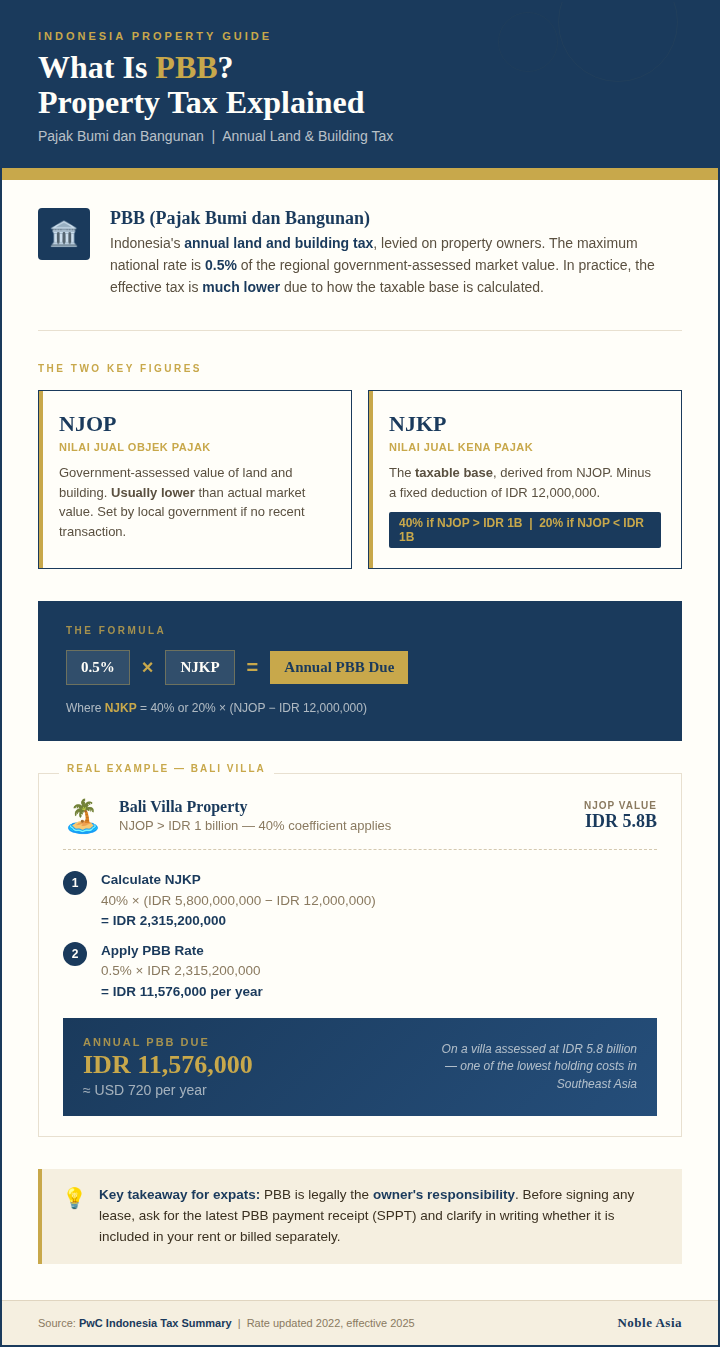
PBB (Pajak Bumi dan Bangunan) is Indonesia’s annual land and building tax, levied on the owner of any property. According to PwC’s Indonesia tax summary, the maximum national PBB rate is 0.5% of the regional government-determined market value. In practice, the effective tax is much lower because of how the taxable base is calculated.
How PBB Is Calculated
The calculation involves two key figures:
- NJOP (Nilai Jual Objek Pajak): The government-assessed value of the land and building, which is typically lower than actual market value
- NJKP (Nilai Jual Kena Pajak): The taxable base, calculated as either 40% of NJOP (for properties valued above IDR 1 billion) or 20% of NJOP (for properties below IDR 1 billion), minus a fixed deduction of IDR 12,000,000
Formula: PBB = 0.5% x NJKP. For example, a Bali villa with an NJOP of IDR 5.8 billion results in: NJKP = 40% x (IDR 5,800,000,000 – IDR 12,000,000) = IDR 2,315,200,000. PBB = 0.5% x IDR 2,315,200,000 = IDR 11,576,000 per year (approximately USD 720). This illustrates why Indonesia’s holding costs are among the lowest in the region.
Who Pays PBB on Rental Properties?
Legally, PBB is the property owner’s obligation. In practice, landlords handle it in one of three ways:
- PBB included in the annual rent (most common for villa and apartment rentals)
- PBB billed separately to the tenant (less common, but occurs especially for commercial premises)
- Landlord pays PBB independently without involving the tenant at all
What this means for expats: Always clarify PBB responsibility before signing any lease. If the landlord has unpaid PBB, it creates legal complications that can affect your occupancy. Ask for the latest PBB payment receipt (SPPT) as part of your due diligence.
Understanding Land Certificates in Indonesia
Indonesia operates a certificate-based land ownership system administered by the BPN (Badan Pertanahan Nasional, or National Land Agency). Unlike many countries where ownership is tracked electronically and assumed on title transfer, in Indonesia the physical certificate is the primary proof of legal ownership. Verifying the authenticity of that certificate at the BPN is the only way to know for certain that the person renting you a property actually owns it.
Critical: Land certificates are frequent targets of fraud and forgery in Indonesia. Photocopies are not sufficient for verification. Always confirm authenticity through a licensed PPAT at the BPN office before committing to a lease.
Key Types of Land Certificates in Indonesia
The certificate type attached to a property determines who can own it, how long the rights last, and what options are available to expat renters. Here is a complete breakdown:
| Certificate | Full Name | Who Can Hold | Duration | Common Use |
| SHM | Hak Milik (Full Ownership) | Indonesian citizens only | No expiration | Residential land, inherited family property |
| HGB | Hak Guna Bangunan (Right to Build) | Indonesian citizens or legal entities (PT PMA for foreigners) | 30 years, extendable up to 80 years total | Apartments, villas, commercial buildings |
| HP | Hak Pakai (Right to Use) | Foreign individuals with KITAS/KITAP or Second Home Visa | 25 years, renewable | Foreign-held residential property (max 1 property) |
| Hak Sewa | Right to Rent/Leasehold | Anyone, including foreigners without residency | 25-30 years, up to 80 years with extension | Expat leasing, most common for foreigners in Bali |
SHM: Hak Milik (Full Ownership)
SHM is the strongest title in Indonesia: permanent, fully transferable, and inheritable with no time limit. Only Indonesian citizens can hold SHM under Agrarian Law No. 5 of 1960. As an expat, you cannot own SHM, but you can legally rent a property sitting on SHM land through a notarized leasehold (Hak Sewa) agreement. Many residential properties in Jakarta and Bali are on SHM land.
HGB: Hak Guna Bangunan (Right to Build)
HGB grants the right to build and own structures on a piece of land for a fixed period, typically 30 years, extendable for another 20 years and renewable for a further 30 years, giving a potential total of 80 years. Most apartments, commercial villas, and resort-style properties in Jakarta’s SCBD and Bali’s Seminyak operate under HGB. Foreign individuals cannot hold HGB directly, but a PT PMA (foreign-owned company) can. One important caveat: when you lease a property on HGB land, confirm that the HGB certificate has sufficient years remaining to cover your intended lease period.
Hak Pakai and Hak Sewa: Expat-Relevant Options
For foreign individuals holding a KITAS, KITAP, or Second Home Visa, Hak Pakai (Right to Use) can be used to own one residential property for an initial 25-year term, with renewal options available.
Meanwhile, Hak Sewa (leasehold) is often the most practical route for expatriates because it does not require residency status. Lease terms commonly range from 25 to 30 years, may be extended up to 80 years depending on the agreement, and gain stronger legal standing when notarized by a licensed PPAT.
Why Expats Must Verify SHM/HGB Before Renting
This step is skipped far more often than it should be, and the consequences can be severe. Here is why verification is not optional:
1. Avoiding illegal rentals. You could unknowingly rent a property from someone who has no legal right to lease it, whether because they are a subletting tenant, an agent without proper authorization, or in the worst case, a fraudster using a forged certificate.
2. Preventing ownership disputes. In Bali particularly, inherited land with multiple heirs and outdated certificates is common. If the person on the certificate is deceased and heirs have not updated the title, multiple parties could claim rights over the property you are renting. A proper check at BPN surfaces these issues before you pay any deposit.
3. Ensuring your lease is valid. A lease is only as legally sound as the landlord’s authority over the property. If the landlord’s right to the property is challenged or void, your lease agreement may be unenforceable, exposing you to eviction without legal recourse.
4. Protecting your deposit. Rental deposits in Indonesia can be substantial, often two to three months of rent or more for annual agreements. Without certificate verification, there is no guaranteed way to recover your deposit if a dispute arises over property ownership.
How to Check Property Legality in Indonesia
Follow this process before committing to any rental of significance:
- Request a copy of the land certificate (SHM, HGB, or HP) and the latest PBB payment receipt from the landlord.
- Compare the name on the certificate with the landlord’s government-issued ID (KTP) and the name appearing on the draft lease agreement. All three must match exactly.
- Engage a licensed PPAT (Pejabat Pembuat Akta Tanah) to perform a Certificate Authenticity Check (Cek Sertifikat) at the BPN. This confirms the certificate is genuine, the title is unencumbered, and no disputes or liens are registered against the property.
- Verify zoning compliance. Confirm that the property is legally permitted for residential use (or commercial use if applicable) under the local RTRW (regional spatial plan). This matters especially for villa rentals in Bali where zoning enforcement has tightened in 2024 and 2025.
- For HGB properties, confirm the certificate has sufficient years remaining to cover your lease period, plus any extensions you intend to negotiate.
- Have your lease agreement formally notarized by the PPAT. A notarized lease carries legal weight in Indonesian courts; an unnotarized one does not.
Note: PPAT fees for document verification and lease notarization typically range from 0.5% to 2.5% of the lease value. For any significant rental commitment, this cost is one of the best investments you can make in Indonesia.
Common Red Flags to Watch Out For
These warning signs should stop any rental process immediately:
| Red Flag | What It Means | What to Do |
| Landlord refuses to show certificate | May not be legal owner or certificate has issues | Walk away. No legitimate owner refuses this |
| Name on certificate does not match person signing lease | Could be fraud, inheritance dispute, or unauthorized agent | Require notarized authorization or halt the process |
| HGB certificate nearing expiry | Your lease rights may not be valid past the HGB term | Confirm renewal status at BPN before signing |
| No PBB payment receipt for current year | Unpaid taxes suggest financial or legal problems | Request at least 3 years of PBB receipts |
| Subleasing from a tenant (not owner) | Sub-lessor may not have legal right to rent to you | Always verify ownership at BPN, not just the lease |
| Only photocopy of certificate provided | Photocopies can be forged; not sufficient for verification | Require BPN verification through a licensed PPAT |
Secure Your Property the Right Way
Indonesia offers exceptional living and investment opportunities, but property transactions here require genuine due diligence. The combination of PBB compliance, certificate verification, and notarized lease agreements is not bureaucratic formality. It is the legal foundation of your entire tenancy. An expat who skips these checks might pay six months of rent before discovering the landlord had no legal right to lease the property. One who does them properly enjoys full contractual protection throughout their stay, in Jakarta’s SCBD, Bali’s Canggu, or anywhere across the archipelago.
Renting in Indonesia? Noble Asia Guides You Through Every Step
Noble Asia helps expats verify property legality, review lease agreements, and secure the right home in Jakarta or Bali. Our team provides property advisory services, relocation support, and villa management across Indonesia, giving you confidence at every stage of the rental process.
Contact our team today for expert property guidance in Jakarta and Bali.
📞 WhatsApp: +62 813 1668 5505
FAQ Property Taxes and Land Certificates in Indonesia
What is PBB in Indonesia?
PBB (Pajak Bumi dan Bangunan) is Indonesia’s annual land and building tax. It is levied at a maximum rate of 0.5% of the government-assessed property value (NJOP), applied to a taxable base (NJKP) of either 20% or 40% of NJOP. The result is an effective annual cost far lower than property taxes in most Western countries.
Do tenants need to pay PBB?
Technically, PBB is the owner’s responsibility. In practice, some landlords include it in rent while others pass it to the tenant separately. There is no universal rule. Your lease agreement should always specify who is responsible, in writing, before you sign.
What is SHM and can a foreigner use it?
SHM (Hak Milik) is the highest form of land ownership in Indonesia, with no expiry and full rights. It is restricted to Indonesian citizens only. Foreigners cannot own SHM, but they can legitimately rent or lease properties that sit on SHM land, through a properly notarized leasehold agreement (Hak Sewa).
What is HGB and how is it different from SHM?
HGB (Hak Guna Bangunan) grants the right to build and use property on land for a fixed term, typically 30 years, extendable to a total of up to 80 years. Indonesian citizens or legal entities (including a PT PMA foreign-owned company) can hold HGB. Many apartments and commercial villas in Jakarta and Bali operate under HGB.
Can foreigners rent property safely in Indonesia?
Yes, provided proper due diligence is done. The key steps are verifying the land certificate at the BPN (National Land Agency) through a licensed PPAT notary, confirming the landlord’s identity matches the certificate, checking PBB payment history, and having all lease agreements formally notarized. Without these steps, risk increases significantly.
How do I check if a land certificate is valid?
Request a copy of the SHM or HGB certificate, then hire a licensed PPAT (Land Deed Official) to perform a Certificate Authenticity Check (Cek Sertifikat) at the local BPN office. This is the only reliable method of verification. Photocopies alone are insufficient as they can be forged.
What happens if PBB is unpaid?
The Indonesian tax authority issues a Tax Due Notice (SPPT) and the owner has six months to pay. Persistent non-payment can result in penalties, legal complications tied to the property, and in some cases, restrictions on title transfer. Unpaid PBB on a rental property can create problems for tenants if the landlord faces enforcement action.
Should I use a notary or property advisor?
For any rental exceeding 6 months or involving significant deposits, using a licensed PPAT notary is strongly recommended. A property advisor with local market knowledge adds another layer of protection by helping you assess the legitimacy of the deal before the notary engagement even begins.