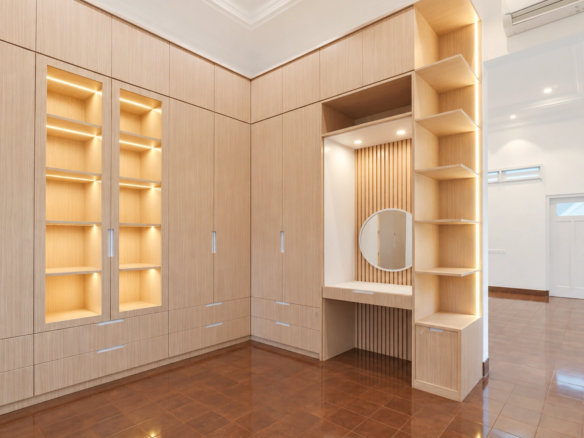

A timber dining table, a stone floor and a woven chair can make a room feel warm, grounded and personal.
But “natural” is not a complete material specification.
A beautiful piece of wood can move or crack if it was not prepared correctly. A pale stone can become difficult to live with when placed in the wrong area. A woven chair may perform well in an air-conditioned apartment but deteriorate quickly on an exposed terrace.
The right question is therefore not simply, “Is this material natural?”
It is:
Is it appropriate for this location, this household and the way the space will actually be used?
This is especially important in Jakarta, Bali and other parts of Indonesia, where humidity, heat, strong sunlight, heavy rainfall, air-conditioning and building conditions can all influence material performance.
Natural materials can create interiors with real depth. They can carry grain, texture, variation, craftsmanship and memory. But they should be selected with the same attention given to layout, lighting and construction.
Why Natural Materials Make a Home Feel Different
Natural materials rarely look completely uniform.
One timber board may have a stronger grain than the next. Two pieces of stone from the same type may contain different markings. Handwoven fibres can show small variations created by the maker and the material itself.
These differences are not necessarily defects. They are often the reason a surface feels alive.
Natural variation creates character
Manufactured finishes are often designed to be predictable. Natural materials bring a quieter form of individuality.
A stone surface may contain a vein that cannot be precisely repeated. Reclaimed timber may show marks from its previous use. Woven fibres may reveal the rhythm of the hands that made them.
The interior gains character without needing excessive decoration.
Materials can gain meaning as they age
Some furniture materials are intended to remain visually perfect. Others develop a patina.
A well-made timber table can carry the memory of family meals. A natural stone floor may soften gradually in frequently used areas. A leather chair may change colour where it is touched most often.
Whether this ageing is desirable depends on the owner. Some people value gradual change. Others prefer a surface that remains consistent and easily restored.
Neither preference is wrong. It simply needs to be understood before the material is approved.
Nature should be part of the experience
Adding a few baskets or timber accessories does not automatically create a nature-connected interior.
A more thoughtful approach considers:
● Natural light
● Air movement
● Shade
● Views
● Texture
● Plants
● Local craftsmanship
● The relationship between indoor and outdoor spaces
● How surfaces feel when touched
● How materials sound and age
Natural materials work best when they support the atmosphere and function of the space—not when they are added as decoration at the end.
Use the Five-Part Material Test
Before choosing any natural material, assess it through five questions.
1. Beauty
What do you genuinely like about it?
Consider its colour, grain, texture, variation and relationship with the other materials in the room. Ask to see a large sample rather than relying on a small image or digitally edited reference.
Natural variation means the installed result may not look identical to one sample.
2. Performance
Where will the material be used?
A bedroom wall, kitchen worktop, shower floor and outdoor terrace place very different demands on a material.
Consider:
● Water exposure
● Humidity
● Direct sunlight
● Heat
● Impact and scratching
● Foot traffic
● Children and pets
● Cleaning products
● Air-conditioning
● Indoor or outdoor use
A material can be excellent in one location and unsuitable only a few metres away.
3. Maintenance
What will the household need to do to protect it?
Ask how frequently the material needs cleaning, refinishing, sealing or professional attention. Clarify which cleaning products should be avoided.
Do not accept “easy to maintain” without an explanation of what the maintenance involves.
4. Sourcing
Where did the material come from, and can its source be explained?
For timber, ask about legal and responsible sourcing, species, supplier records and certification where relevant. FSC certification is one recognised system intended to support responsible forest management. FSC states that its forest-management certification considers biodiversity, local communities and workers, and long-term economic viability (Forest Stewardship Council).
Local is not automatically responsible, and imported is not automatically better. The important point is traceability, suitability and credible supplier information.
5. Afterlife
Can the material be repaired, refinished, reused or separated when the interior changes?
A solid timber table may be repaired several times. A well-selected stone slab could be reused. A modular item can move to another room or property.
Longevity is not only about how long a product resists damage. It is also about whether people will continue to value and use it.
How to Choose Natural Wood for an Interior
Wood is one of the most versatile interior materials, but choosing it only by species or colour can lead to problems.
Wood responds to surrounding moisture conditions. The USDA Forest Products Laboratory explains that moisture exchange between wood and air has an important influence on wood properties and performance (Wood Handbook, Chapter 4). Correct drying, handling and storage help limit unwanted dimensional changes after installation.
Species is only one part of the decision
When approving wood, ask about:
● Species
● Moisture content
● Seasoning and drying
● Board construction
● Grain direction
● Joinery
● Surface preparation
● Finish
● Intended location
● Maintenance
● Supplier experience
A familiar species can still perform poorly when it is inadequately dried, incorrectly joined or used in the wrong place.
The quality of the workshop and construction detail can matter as much as the timber name.
Solid wood, veneer and reclaimed wood
Each has an appropriate role.
Solid wood offers depth, repairability and natural variation. It can work beautifully for tables, chairs, doors and selected joinery, but its natural movement must be understood.
Natural veneer uses a thin layer of real timber over a stable substrate. It can achieve consistency across large cabinet surfaces and use valuable timber more efficiently. Edge details, substrate quality and adhesive selection need proper specification.
Reclaimed wood carries history and visual character. It can be transformed into furniture or architectural features that cannot be easily repeated. However, it must be inspected, cleaned, stabilised and prepared for its new use.
Reclaimed timber should not be selected only because it sounds sustainable. Its condition and suitability still require professional assessment.
Where wood works well
Wood can bring warmth to:
● Flooring
● Wall panels
● Cabinet fronts
● Built-in furniture
● Dining tables
● Bed frames
● Doors
● Ceiling details
● Decorative screens
● Freestanding furniture
In Jakarta apartments, timber can soften glass, stone and polished building finishes. In Bali villas, it can connect the interior to the landscape—but exterior or semi-exterior use needs a very different specification from an air-conditioned bedroom.
Questions to ask before approving timber
● Is the wood suitable for indoor, outdoor or semi-outdoor use?
● How was it dried?
● Has its moisture condition been checked?
● Is it solid timber, veneer or an engineered construction?
● What finish will be applied?
● Can the finish be repaired locally?
● How will joints accommodate natural movement?
● Is the source documented?
● What maintenance will be required?
● Can I see a completed item made by the same workshop?
Choosing Natural Stone for Floors, Walls and Surfaces
Stone can feel permanent and refined, but “natural stone” includes materials with very different properties.
Not every stone performs in the same way
Marble, granite, limestone and travertine differ in composition, porosity, surface behaviour and maintenance needs.
Even stones sold under the same commercial name may vary by quarry, batch and finish.
The material should therefore be chosen for the exact application—not simply because it looks impressive in a showroom.
Marble, granite, limestone and travertine
Marble offers distinctive movement and veining. It can be beautiful on walls, vanity surfaces and selected floors, but some types can etch or stain when exposed to acidic substances.
Granite is often selected for harder-working surfaces, although performance and appearance still vary between types and finishes.
Limestone can create a quiet, soft atmosphere. Its suitability depends on the stone, finish, exposure and expected maintenance.
Travertine brings texture and warmth. Filled, unfilled, honed and textured versions behave and look differently.
No stone should be described simply as “maintenance-free.”
Stone finish matters
A polished surface reflects light and intensifies colour but may show marks differently from a honed finish.
A textured finish can provide grip but may collect dirt more easily. Very rough stone can be difficult to clean in a shower or food-preparation area.
The right finish depends on use, safety, appearance and maintenance—not fashion alone.
Plan for cleaning and sealing
Care requirements depend on the stone’s composition and application. Spills should generally be addressed promptly, and cleaners should be compatible with the specific stone; acidic or unsuitable all-purpose products can damage certain surfaces.
Before installation, confirm:
● Whether sealing is recommended
● How often it may need to be repeated
● Which cleaner should be used
● How stains will be treated
● Whether the finish can be restored
● Who is responsible for future maintenance
Bamboo and Rattan: Light, Natural and Material-Specific
Bamboo and rattan are often grouped together, but they are different materials with different uses.
Bamboo needs correct treatment and construction
Bamboo can be used in furniture, screens, panels and engineered surfaces. Its performance depends on species, age, location, processing and treatment. Treatment is especially important for improving durability.
Look beyond the word “bamboo” and ask how the product was made.
Rattan is not suitable for every location
Rattan can create lightness, texture and visual warmth. It works well in chair backs, cabinet inserts, screens and selected furniture.
However, woven surfaces can collect dust, and untreated material may not suit exposed outdoor conditions. A rattan-look item and natural rattan may also have different maintenance requirements.
Clarify whether the product is natural, synthetic or a combination.
Avoid turning local craft into a theme
Indonesian materials and craftsmanship can give a space real identity. They do not need to become a collection of predictable decorative symbols.
One beautifully made woven panel or carefully designed furniture piece can communicate more than a room filled with loosely related “tropical” objects.
Use local craft as part of the architecture, function or story of the space—not as a costume.
Natural Fabrics and Fibres
Linen, cotton, wool and jute can add softness and texture, but their suitability depends on location and use.
Consider cleaning, sunlight and moisture
Before selecting a natural textile, ask:
● Is it washable or dry-clean only?
● Will it receive strong direct sunlight?
● Is it suitable for upholstery or decorative use?
● Does it crease easily?
● How will it respond to children or pets?
● Could the area become damp?
● Is the cover removable?
● Can the fabric be replaced locally?
A beautiful natural fabric may be ideal for bedroom curtains but impractical for a dining chair used by young children every day.
Use removable textiles for flexibility
Cushions, rugs, throws and removable upholstery allow a room to change without replacing its main furniture or construction materials.
They are a useful way to introduce colour and natural texture while keeping the foundational design calm and durable.
How Materials Should Change by Property Type
Apartments in Sudirman, SCBD, Thamrin and Kuningan
Central Jakarta apartments usually benefit from carefully controlled material palettes.
Use natural materials to add warmth, but consider:
● Furniture and lift access
● Building renovation rules
● Weight restrictions
● Fixed air-conditioning conditions
● Direct sunlight through large windows
● Compact storage
● Cleaning and maintenance access
A large amount of heavily patterned timber and stone can overwhelm a smaller apartment. One leading timber tone, one restrained stone and a limited textile palette will usually feel more composed.
Family homes in Kemang, Menteng and Pondok Indah
Landed homes can support a wider variety of materials, but transitions need careful planning.
Indoor, covered outdoor and fully exposed areas should not automatically receive the same wood, stone or finish.
Consider children, pets, household staff, garden moisture, entrance dirt and larger entertaining areas. A material palette should be attractive enough for formal occasions but robust enough for normal family life.
Villas in Bali
A Bali villa must respond to more than appearance.
For a personal residence, materials can reflect the owner’s rituals and preferences. For a rental villa, they also need to support:
● Guest turnover
● Housekeeping
● Wet swimwear
● Luggage
● Outdoor exposure
● Replacement availability
● Photography
● Maintenance access
● Operational consistency
A material that is difficult to source again may become a long-term problem when one item is damaged.
Villa design should connect to its setting without sacrificing operational practicality.
Rental and investment properties
Owners should avoid selecting materials only for the opening photographs.
Ask:
● Can the material handle repeated occupancy?
● Is it easy to explain to tenants or guests?
● Can local teams maintain it?
● Can damaged sections be repaired without replacing everything?
● Will it still suit the intended market in several years?
● Does it strengthen the property’s positioning?
The most expensive natural material is not always the best investment. The strongest choice is the one that supports the property’s use, market and maintenance plan.
How to Combine Natural Materials Without Making the Room Too Busy
Natural materials already contain visible movement and texture. Too many strong materials can compete.
Use a simple hierarchy:
- Choose one leading material.
- Add one supporting natural material.
- Use a quieter background.
- Repeat one colour or undertone.
- Vary texture more than colour.
- Leave visual space around distinctive pieces.
For example, a reclaimed timber dining table may lead the room. A quiet limestone floor can support it, while linen curtains soften the composition.
The goal is not to display every natural material available. It is to let a few good materials be properly seen and used.
Are Natural Materials Always the More Sustainable Choice?
No material becomes sustainable simply because it came from nature.
A natural material may still be poorly sourced, transported unnecessarily, treated with unsuitable chemicals, installed wastefully or replaced quickly because it was wrong for the application.
A more responsible decision considers:
● Legal and transparent sourcing
● Durability
● Appropriate use
● Manufacturing and treatment
● Transportation
● Repairability
● Maintenance
● Waste during fabrication
● Expected lifespan
● Possibility of reuse
Sometimes the most responsible decision is to restore an existing floor, reuse old furniture or select a stable composite for a demanding location rather than repeatedly replace an unsuitable natural material.
Sustainability begins with asking whether the material will be valued and used for a long time.
Common Mistakes When Selecting Natural Materials
Choosing from a small sample
Review larger samples and understand expected variation before approving a complete order.
Ignoring humidity and moisture movement
Timber, woven fibres and some stones need material-specific preparation and detailing.
Using the same material indoors and outdoors
A protected interior and an exposed terrace create completely different conditions.
Prioritising appearance over touch and use
Sit on the chair. Walk on the floor. Touch the finish. Open the cabinet. A material is part of a physical experience.
Assuming premium means delicate
A premium material should be appropriate and honestly specified. It should not create unnecessary anxiety every time the home is used.
Forgetting future repairs
Confirm whether replacement boards, stone, fabrics or finishes will remain available.
Believing every environmental claim
Ask what “natural,” “responsible,” “recycled” or “non-toxic” specifically means and what evidence supports the description.
Build a Material Palette That Can Live With You
The best natural-material interiors are not necessarily the ones using the greatest amount of timber, stone or woven fibre.
They are the ones where each material has a reason to be there.
The timber is chosen for its construction and character. The stone suits the surface and maintenance expectations. The textile feels good and can be cleaned. The craft is respected. The sourcing can be explained. The materials support the architecture, daily routine and life of the property.
Natural materials should not only look beautiful on handover day.
They should continue to feel appropriate as the home is lived in, the villa welcomes guests or the property moves through different stages of ownership.
Planning a home, apartment or villa in Jakarta or Bali? Noble Design Asia can help you compare materials, assess samples and create a material palette that balances beauty, function, climate and long-term care.
📩 connect@nobleasia.id | 📞 WhatsApp: +62 813 1668 5505
Frequently Asked Questions
1. What natural materials are used in interior design?
Common options include timber, natural stone, bamboo, rattan, clay, leather, linen, cotton, wool and jute. Their suitability depends on location, construction, finish, maintenance and how the room will be used.
2. What is the best natural material for a home interior?
There is no single best material. Timber may be ideal for furniture, stone for selected floors or surfaces, and linen for removable textiles. The strongest choice is the one that fits the application and maintenance expectations.
3. What is the best wood for furniture in a humid climate?
Species matters, but it is not the only consideration. Proper drying, stable construction, suitable joinery, correct finishing and experienced fabrication are also essential. Ask the supplier how the timber was prepared for its intended environment.
4. Is teak good for indoor furniture?
Well-selected and properly prepared teak can be used for long-lasting indoor furniture. Review the timber’s source, condition, construction, finish and craftsmanship rather than relying only on the species name.
5. Does natural stone need to be sealed?
Some stones and applications benefit from sealing, while requirements differ according to the stone’s composition, finish and use. Ask the supplier or installer for a written cleaning and maintenance recommendation.
6. Is marble practical for a kitchen?
Marble can be used in a kitchen, but the owner should understand that certain types may stain or etch when exposed to oils, acids and frequent food preparation. A more forgiving stone or surface may be preferable for households seeking low maintenance.
7. Can I mix different types of natural material wood in one room?
Yes. Keep the undertones reasonably connected and establish a hierarchy. One wood should lead, while the others support it. Repeating a finish or colour elsewhere in the room can make the combination feel intentional.
8. Is rattan suitable for outdoor furniture?
Natural rattan is generally better suited to indoor or carefully protected areas unless it has been specifically prepared for the conditions. Synthetic woven materials may be more practical for fully exposed outdoor furniture.