
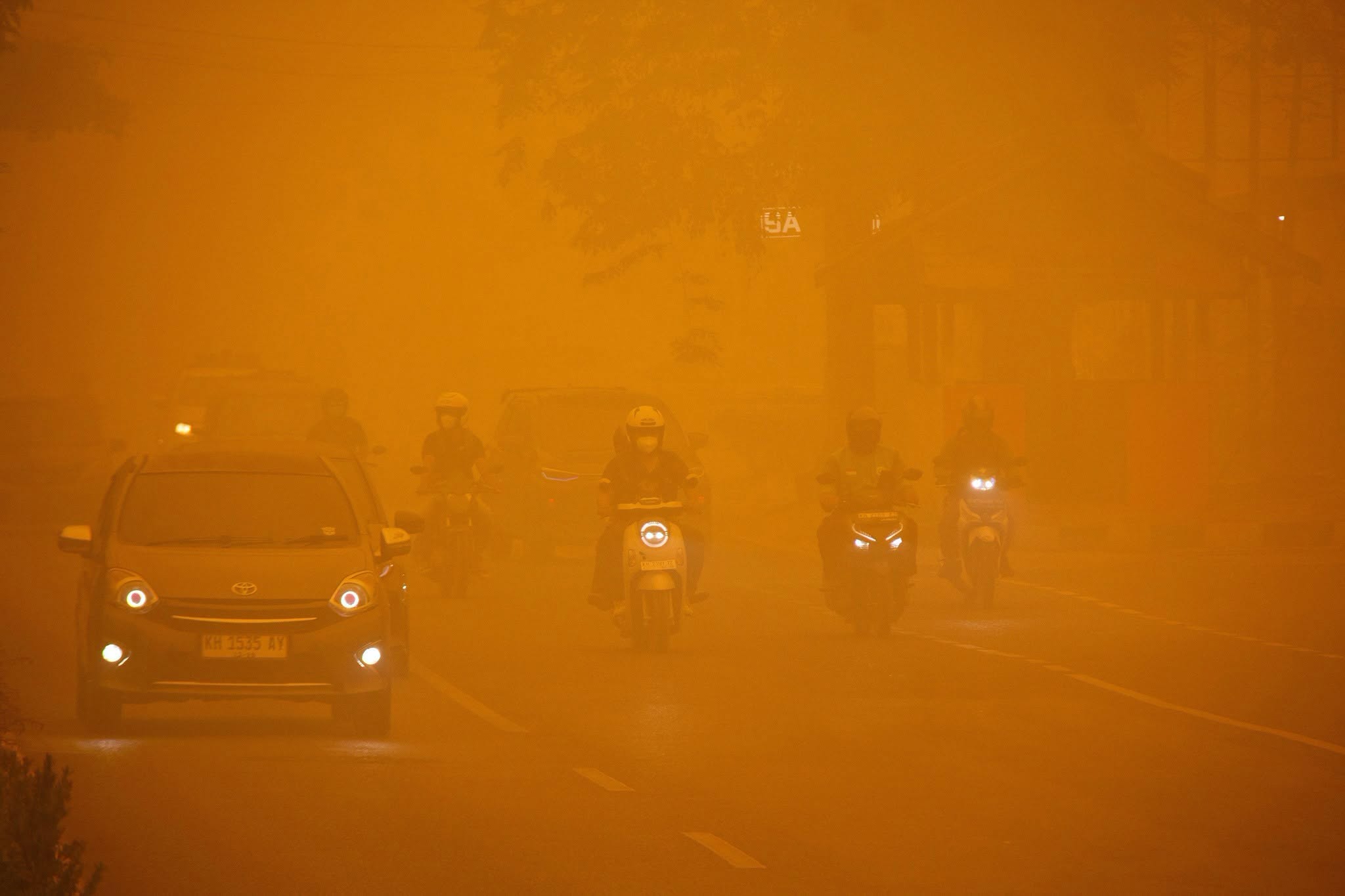
Air quality categories checked against the Ministry of Environment’s ISPU portal and Regulation P.14/MENLHK/SETJEN/KUM.1/7/2020. Health advice follows the Ministry of Health, the Ministry of Environment and WHO.
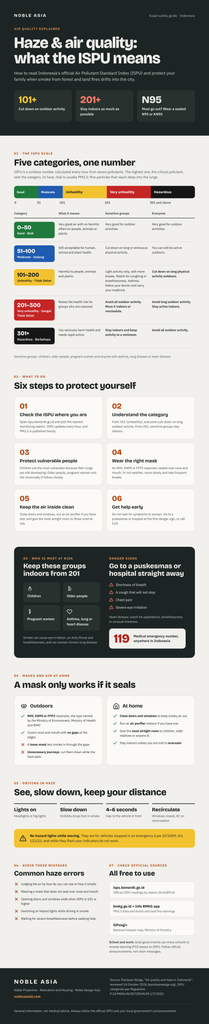
In short: Indonesia measures air quality with ISPU: 0 to 50 Good, 51 to 100 Moderate, 101 to 200 Unhealthy, 201 to 300 Very Unhealthy, and 301 or above Hazardous. Above 100, cut down on outdoor activity. Above 200, keep children, older people, pregnant women and anyone with heart or lung disease indoors. Outside, wear a sealed N95 or KN95 mask.
Haze is easy to recognise and hard to judge. A grey sky can hide very little pollution, and a clear blue one can carry a lot. In mid-October 2026, satellite images from BMKG, Indonesia’s meteorology agency, picked up smoke from forest and land fires in the atmosphere above Jakarta. BMKG’s Principal Secretary, Guswanto, made a point worth remembering: what decides the health risk is the measured PM2.5 at ground level, not the satellite picture. Three days later, the Jakarta provincial government said it was ready to recommend remote learning for students if air quality worsened significantly.
This guide explains what causes haze, where to check reliable readings, why apps can disagree, and the practical steps that protect your household.
Emergency numbers to save in Indonesia
For a medical emergency, call 119. The other contacts below cover different types of incidents; choose the service that matches the situation.
| CALL | SERVICE | WHEN TO USE IT |
|---|---|---|
| 112 | Integrated emergency service | General emergencies where the local service operates. Coverage varies by area. |
| 110 | Police | Incidents requiring police assistance. |
| 113 | Fire service | Fire emergencies. Also save your local fire service’s direct number. |
| 115 | Basarnas search and rescue | Emergencies requiring search and rescue. |
| 117 | BNPB disaster operations | Disaster reporting and coordination through Pusdalops BNPB. |
| 119 | Medical emergency service | Medical emergencies and requests for emergency medical assistance. |
| 129 | SAPA support for women and children | Report violence against women or children and seek support. |
112 is managed locally and has not been implemented everywhere. Save direct local contacts before an emergency. If a call does not connect, contact the relevant local service or hospital directly without delaying help. Give the exact address, nearby landmark, nature of the emergency, and a callback number.
Understand the issue: it’s more than a hazy sky
Two different problems tend to get called “haze” in Indonesia, and they behave differently.
Smoke from forest and land fires. Fires in parts of Sumatra and Kalimantan, most common in the dry season, produce smoke that can travel hundreds of kilometres. In 2026, BMKG flagged August and September as months of high fire risk, and smoke reached the upper atmosphere over Jakarta in October. Whether it affects the air you breathe depends on whether it sinks to the surface, which is why ground-level monitoring matters more than how the sky looks.
Everyday urban pollution. Jakarta’s air is also shaped by vehicle and industrial emissions, and it tends to be worse in the dry season. The provincial government named transport, industry and the dry season when it explained why it stays alert even after fire smoke moves away.
In both cases the pollutant to watch is usually PM2.5: particles 2.5 micrometres across or smaller. The Ministry of Environment’s ISPU portal describes them as fine enough to reach the air sacs of the lungs, with links to heart and lung disease and stroke. According to the Ministry of Health, short-term exposure to fire smoke can cause eye irritation, an itchy throat and breathlessness, and can make chronic lung conditions worse.
Can you judge air quality by looking at the sky?
No. Visibility and smell are poor guides. Fine particles can be present on a day that looks clear, and a hazy view can come from humidity rather than pollution. Check the nearest monitoring station before deciding whether to run outdoors, walk to school or open the windows.
Stay informed: check the air, not just the weather
Several free sources publish air quality readings in Indonesia. The official ones use the ISPU index; private apps usually use the US Air Quality Index (AQI).
| Source | Run by | What it shows | Best for |
| ISPU portal, ispu.kemenlh.go.id | Ministry of Environment / Environmental Control Agency (KLH/BPLH) | Official ISPU by station, updated hourly | The national reference reading |
| Udara Jakarta, udara.jakarta.go.id | Jakarta Environment Agency (DLH DKI) | ISPU by station and district, PM2.5, three-day forecast from BMKG, health advice | Day-to-day decisions in Jakarta |
| BMKG air quality pages and the Info BMKG app | BMKG | PM2.5 concentrations, fire and smoke warnings, satellite smoke images | Seeing where smoke is heading |
| SiPongi+ | Ministry of Forestry | National map of fire hotspots | Understanding where fires are burning |
| IQAir and similar apps | Private companies | US AQI, often with crowd-sourced sensors | A second opinion; not used for official decisions |
Udara Jakarta was launched by the Jakarta Environment Agency in July 2024, drawing on 31 monitoring stations at launch together with data from BMKG and research partners. Beyond readings, it includes a symptom checker, a map of nearby health facilities and a form to report smoke from waste burning.
Under Regulation P.14/MENLHK/SETJEN/KUM.1/7/2020, ISPU is calculated every hour. PM2.5 results are published hourly, and when the index reaches Unhealthy or worse, every parameter is published hourly. The parameter with the highest value, often PM2.5, sets the category.
What each ISPU category means for your day
| ISPU | Category | Sensitive groups | Everyone else |
| 0 to 50 | Good (Baik) | Outdoor activity is fine | Outdoor activity is fine |
| 51 to 100 | Moderate (Sedang) | Cut down on long or strenuous outdoor exercise | Outdoor activity is still acceptable |
| 101 to 200 | Unhealthy (Tidak Sehat) | Light activity only, with more breaks; watch for coughing or breathlessness | Cut down on long outdoor activity |
| 201 to 300 | Very Unhealthy (Sangat Tidak Sehat) | Avoid outdoor activity; move it indoors or reschedule | Avoid long outdoor activity |
| 301 and above | Hazardous (Berbahaya) | Stay indoors and keep activity to a minimum | Avoid all outdoor activity |
Sensitive groups: children, older people, pregnant women, and people with asthma, lung disease or heart disease. Advice summarised from the KLH/BPLH ISPU portal.
Why IQAir and the official ISPU show different numbers for the same air
ISPU and the US AQI both run from 0 to 500 and use similar colours, but they convert PM2.5 concentrations into index numbers with different thresholds, so the same air can get a different score and label. ISPU calls PM2.5 up to 15.5 micrograms per cubic metre Good and up to 55.4 Moderate. The US AQI, updated by the US EPA in May 2024, calls only up to 9.0 Good and treats 35.5 to 55.4 as Unhealthy for Sensitive Groups. Our haze post on Instagram shows the gap: a Jakarta reading of 147 on the US AQI, with PM2.5 at 54.0, sits at roughly 98 on ISPU, still within Moderate. Neither app is wrong. The official ISPU is what local governments use for decisions such as moving schools online. If you or your children are in a sensitive group, using the stricter US label as your personal trigger is a reasonable choice. The WHO’s 24-hour guideline for PM2.5 is 15, while Indonesia’s national 24-hour standard is 55.
| PM2.5 (µg/m³) | Approximate ISPU | Approximate US AQI |
| 12 | 39, Good | 56, Moderate |
| 30 | 69, Moderate | 90, Moderate |
| 54 | 98, Moderate | 147, Unhealthy for Sensitive Groups |
| 80 | 127, Unhealthy | 168, Unhealthy |
| 140 | 189, Unhealthy | 215, Very Unhealthy |
Calculated by Noble Asia from the PM2.5 breakpoints used for ISPU and the US EPA breakpoints effective 6 May 2024. Official portals calculate values from their own monitoring data and averaging periods, so treat these as a guide to the difference, not a converter.
Protect your everyday life: small steps can make a difference
When readings climb, most of what helps is simple and costs little.
Move activity indoors. From Unhealthy (101 and above), shorten outdoor exercise and swap long runs, football practice or long walks for indoor alternatives. At Very Unhealthy and above, sensitive groups should not be active outdoors at all, which is what the Ministry of Environment asks.
Keep outdoor air out. Close doors and windows while readings are Unhealthy or worse. The Ministry of Health advises keeping outdoor air out of the home and using an air purifier indoors where available, and WHO gives the same advice to stay inside with windows shut unless authorities tell you to leave.
Make one room your clean room. If you have one purifier, put it in the room that seals best and use it for whoever is most at risk: a baby, an older relative, someone with asthma. A purifier works best in a closed room that suits its stated capacity, with the filter changed as the manufacturer recommends.
Plan errands for better hours. Readings move through the day. Check the hourly figure on the ISPU portal or Udara Jakarta before school runs and outdoor plans rather than relying on the morning’s number.
Which masks work against haze?
A well-fitting respirator: N95, KN95 or the European equivalent, FFP2. The Ministry of Environment asks anyone who must be outside during Very Unhealthy readings to wear an N95 or KN95, the Ministry of Health recommends respirators such as the N95, and WHO advises a well-fitting FFP2 or N95 covering both nose and mouth. Fit is what makes it work. Cloth and loose surgical masks leave gaps at the sides, and smoke goes through the gaps. In Jakarta’s heat a respirator makes exertion harder, so walk rather than hurry and take breaks.
Danger signs: when to get medical help
Go to a community health centre (puskesmas) or hospital straight away if someone develops shortness of breath, a cough that will not stop, chest pain or severe eye irritation. The Ministry of Health asks people not to wait until symptoms get worse. People with heart disease should also watch for palpitations, breathlessness or unusual tiredness. Anyone with asthma should keep their medicine with them and follow their doctor’s plan. In a medical emergency, call 119.
Schools and offices during haze
Regional heads and education offices can move schools to remote learning (pembelajaran jarak jauh, PJJ) based on official ISPU readings, as Jambi City did in September 2026. In October 2026, the Jakarta provincial government said remote learning was an option if air quality worsened significantly, alongside limits on outdoor activity for vulnerable groups. Follow announcements from your child’s school and the provincial government, not forwarded chain messages. For employers, a clear rule written in advance, for example “outdoor site visits move or pause when the nearest station passes ISPU 200”, saves a lot of discussion on a bad morning.
Driving in smoke
When smoke or haze reduces visibility, Indonesia’s traffic police advise switching on headlights or fog lights and slowing down. Do not drive with hazard lights on: under Article 121(1) of Law 22 of 2009, they are for vehicles stopped in an emergency, and while they are on, your indicators cannot signal a turn. Keep a gap of four to six seconds behind the vehicle in front. WHO adds a simple one for the car itself: windows up and air conditioning on recirculate.
Choosing a home in Jakarta with air quality in mind
For families moving to Jakarta, air quality is a fair question to bring to a viewing. No building makes outdoor air irrelevant, but some homes make it much easier to keep indoor air clean. Questions worth asking:
- Do the windows and balcony doors close tightly? A room that seals well is the base for everything else.
- When was the air conditioning last serviced, and who looks after it? Ask the landlord or building management how often units and filters are cleaned.
- Is there a sensible place for an air purifier in the bedrooms, with a power point nearby?
- What is right outside? Look at the roads, construction sites and any open burning near the unit, and check the nearest station on Udara Jakarta for the district.
- Does the building describe any air filtration features? If so, ask what they are and how they are maintained, and judge the answer on specifics.
Look out for yourself, look out for each other
Haze is a shared problem, and some of the most useful steps are social ones.
Share reliable information. Forward links to the ISPU portal or Udara Jakarta rather than screenshots without dates or stations. A reading from another city, or from last week, can cause unnecessary worry or false comfort.
Check on people who are more at risk. Older neighbours, household staff who work outdoors, drivers and families with young children may not be watching the readings. A short message when the index passes 200 is worth sending.
Report what you see. In Jakarta, Udara Jakarta has a form to report smoke from waste burning or chimney emissions. Nationally, SiPongi+ shows where fire hotspots have been detected.
Frequently asked questions
What does an ISPU reading of 150 mean?
An ISPU of 150 falls in the Unhealthy category, which runs from 101 to 200. Everyone should cut down on long outdoor activity. Children, older people, pregnant women and people with asthma, heart or lung disease can go out for light activity, but should take more breaks and watch for coughing or breathlessness.
Why does IQAir show a higher number than the official ISPU?
The two indexes turn the same PM2.5 concentration into different numbers. At 54 micrograms per cubic metre, the US AQI used by IQAir gives about 147, Unhealthy for Sensitive Groups, while ISPU gives about 98, Moderate. Official decisions in Indonesia follow ISPU; sensitive groups may prefer the stricter reading.
Is Jakarta’s haze caused by forest fires?
Sometimes, but not only. Smoke from fires in Sumatra and Kalimantan can reach Jakarta, as BMKG detected in October 2026. Jakarta’s air is also affected by vehicle and industrial emissions, especially in the dry season. Ground-level PM2.5 readings, not the colour of the sky, show what you are actually breathing.
Which mask works against haze?
A well-fitting respirator: N95, KN95 or FFP2. Indonesia’s Ministry of Environment, its Ministry of Health and WHO all recommend this type. It must seal around your nose and mouth, because smoke gets in through gaps. Cloth masks and loose surgical masks give little protection against the fine particles in haze.
Should children still go to school during haze?
Follow the decision of the school and the local government. Regional heads and education offices can move schools to remote learning based on official ISPU readings, and Jakarta said in October 2026 that this was an option if air quality worsened significantly. Children are among the most vulnerable, so limit their outdoor activity on bad days.
Where can I check Jakarta’s official air quality?
Use udara.jakarta.go.id, run by the Jakarta Environment Agency, for readings by district and a three-day forecast. The national ISPU portal at ispu.kemenlh.go.id gives official readings across Indonesia, and BMKG publishes PM2.5 data and fire smoke warnings. All of them are free to use.


Join The Discussion